
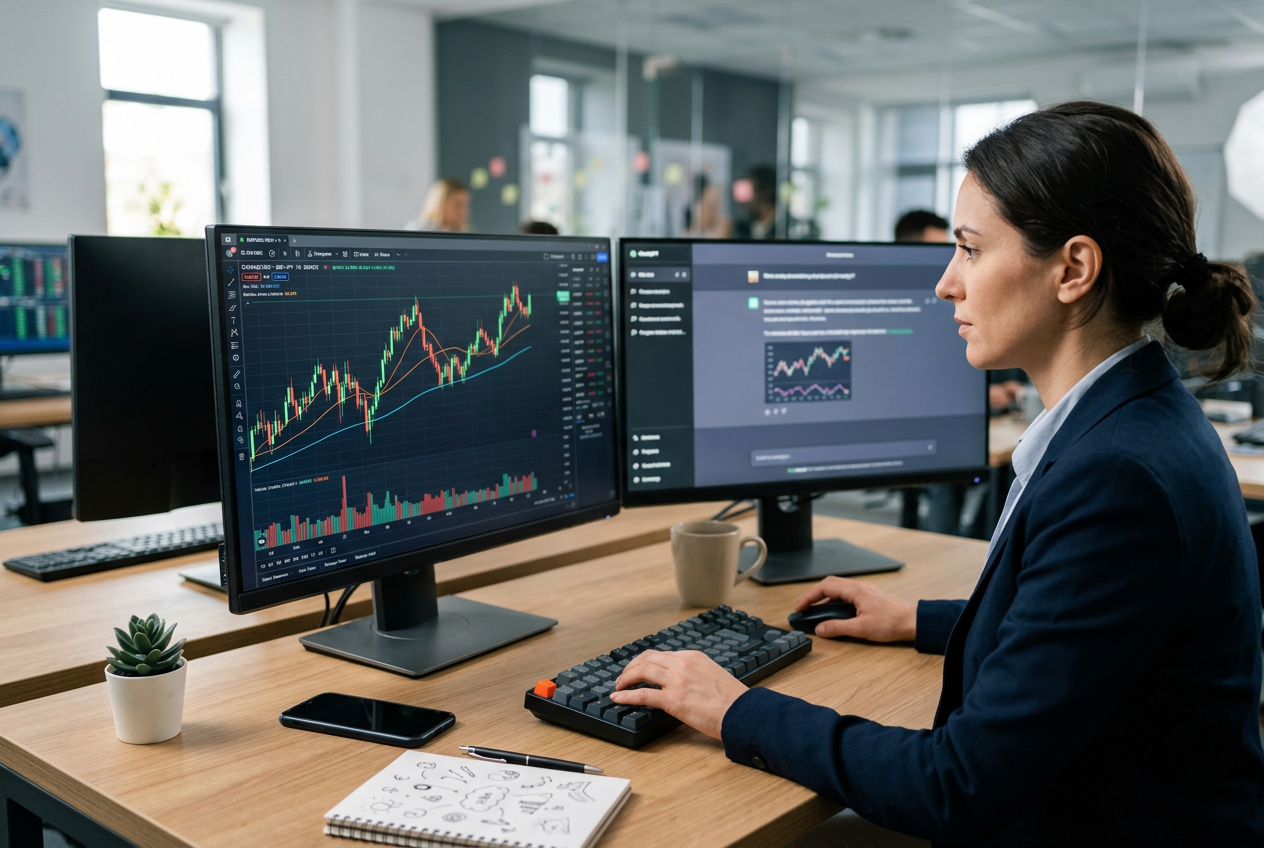
How to Use ChatGPT for Forex Market Analysis
The foreign exchange market processes over seven trillion dollars in daily volume, making it the largest and most liquid financial market on the planet. For individual traders attempting to analyze this vast ecosystem, the challenge has always been one of scale: how does one person monitor dozens of currency pairs, track central bank policies across multiple continents, and stay current with geopolitical developments that shift sentiment within minutes? This is where artificial intelligence enters the conversation, and specifically where ChatGPT forex market analysis capabilities have begun reshaping how retail traders approach their research and decision-making processes.
Large language models do not predict price movements with any reliability, and anyone suggesting otherwise misunderstands both the technology and market dynamics. What these tools excel at is processing, summarizing, and explaining information at speeds no human can match. A trader who previously spent three hours reading Federal Reserve meeting minutes, European Central Bank press conferences, and Bank of Japan policy statements can now condense that research into thirty minutes of focused analysis. The goal is not to replace your judgment but to amplify your analytical capacity, freeing cognitive bandwidth for the pattern recognition and risk assessment that ultimately determine profitability.
The Role of AI in Modern Forex Trading
The integration of artificial intelligence into retail trading workflows represents a fundamental shift in how individuals compete with institutional players. Large financial institutions have employed algorithmic systems and machine learning models for decades, creating an information asymmetry that retail traders have struggled to overcome. ChatGPT and similar models do not eliminate this gap entirely, but they provide accessible tools that were simply unavailable to individual traders five years ago.
Understanding what these models can and cannot accomplish is essential before incorporating them into any trading strategy. Unrealistic expectations lead to poor implementation, which leads to losses that could have been avoided with proper preparation.
Capabilities and Limitations of Large Language Models
ChatGPT excels at natural language processing tasks that would otherwise consume significant portions of your research time. The model can summarize lengthy economic reports into digestible bullet points, explain complex financial concepts in accessible language, and identify themes across multiple documents that a human reader might miss when fatigued. It can also generate code for custom indicators, help structure trading rules into systematic frameworks, and serve as a sounding board for strategy refinement.
The limitations are equally important to understand. ChatGPT does not have access to real-time market data unless connected to external tools, and its training data has a knowledge cutoff that makes it unreliable for recent events. The model cannot predict price movements, and any output suggesting specific entry or exit points should be treated with extreme skepticism. It also lacks the ability to account for your personal risk tolerance, account size, or psychological tendencies. These factors remain entirely your responsibility.
Perhaps most critically, the model can generate confident-sounding responses that are factually incorrect. Cross-verification with authoritative sources is not optional; it is a requirement for any serious trading application.
Integrating ChatGPT into Your Trading Workflow
Effective integration requires identifying specific bottlenecks in your current process where AI assistance provides genuine value. Start by auditing how you spend your pre-market preparation time. If you find yourself skimming economic calendars without truly absorbing the information, that represents an opportunity for AI summarization. If you struggle to articulate why certain setups appeal to you, conversational exploration with ChatGPT can help crystallize your intuitions into explicit rules.
The model works best as a research assistant rather than a decision-maker. You might ask it to explain the relationship between interest rate differentials and carry trades, then use that understanding to inform your own analysis of current rate expectations. You might request a summary of the last three FOMC statements, looking for shifts in language that suggest policy changes. The key is maintaining your role as the final arbiter of all trading decisions while delegating information processing to the AI.
Fundamental Analysis and Sentiment Tracking
Fundamental analysis in forex revolves around macroeconomic factors that drive currency valuations over medium to long time horizons. Interest rates, inflation expectations, employment data, trade balances, and political stability all contribute to how markets price currency pairs. The challenge for retail traders has always been synthesizing this information quickly enough to act before the market fully prices in new developments.
Summarizing Economic Reports and Central Bank Statements
Central bank communications often span dozens of pages filled with carefully chosen language that requires interpretation. The Federal Reserve’s meeting minutes, for example, contain nuanced discussions about inflation expectations, labor market conditions, and policy trajectory that move markets when traders identify shifts in tone. ChatGPT can process these documents and highlight key passages that differ from previous communications.
A practical approach involves feeding the model the current statement alongside the previous one, then asking it to identify specific language changes and their potential implications. You might prompt: “Compare these two FOMC statements and identify any shifts in language regarding inflation expectations or the timing of rate adjustments.” The model will flag phrases that have been added, removed, or modified, giving you a starting point for deeper analysis.
Economic reports from agencies like the Bureau of Labor Statistics or Eurostat follow predictable formats that the model understands well. Non-farm payrolls, Consumer Price Index releases, and GDP figures can all be summarized with emphasis on the components most relevant to currency traders.
Analyzing Market Sentiment from News Headlines
Market sentiment often shifts before fundamental data confirms the change, making news flow analysis a valuable leading indicator. ChatGPT can process batches of headlines from financial news sources and identify prevailing themes, though you must provide the headlines since the model lacks real-time access. Copying twenty or thirty recent headlines about a specific currency pair and asking the model to characterize the overall sentiment provides a quick temperature check.
The model can also help you understand how specific news events historically affect currency pairs. While it cannot predict future reactions, it can explain the typical market logic behind movements following certain announcements. Understanding why markets react in particular ways improves your ability to anticipate rather than simply react.
Assisting with Technical Analysis and Strategy Building
Technical analysis involves identifying patterns in price data that suggest future directional bias or optimal entry and exit points. While ChatGPT cannot see charts or process real-time price data directly, it serves as an excellent educational resource and strategy development partner.
Explaining Complex Technical Indicators
Many traders use indicators without fully understanding the mathematics behind them, which leads to misapplication and false confidence. ChatGPT can explain how any indicator is calculated, what market conditions it was designed to identify, and common pitfalls in its interpretation. If you have ever wondered why the Relative Strength Index sometimes fails to signal reversals or why moving average crossovers generate excessive whipsaws in ranging markets, the model can provide detailed explanations.
Consider asking the model to compare similar indicators and explain when each might be more appropriate. The differences between simple, exponential, and weighted moving averages matter for specific applications, and understanding these distinctions helps you select tools that match your trading timeframe and style. You might also explore oscillators like Stochastic, MACD, or CCI, asking the model to explain their construction and ideal use cases.
Generating and Refining Trading Rules
Systematic trading requires explicit rules that remove discretion from execution. Many traders have intuitions about what constitutes a good setup but struggle to articulate those intuitions precisely. ChatGPT excels at this translation process, helping you convert vague preferences into testable criteria.
You might describe a setup you find appealing in conversational terms, then ask the model to formalize it into specific rules. “I like to buy when price pulls back to support after a strong move up, especially if volume decreases during the pullback” becomes a set of defined conditions involving price action, support identification methods, and volume analysis. The model can also suggest additional filters or conditions you might not have considered, expanding your systematic framework.
Coding Custom Indicators and Automated Scripts
One of the most practical applications of ChatGPT for forex traders involves code generation for trading platforms. Even traders without programming experience can create custom indicators and automated strategies by describing their requirements in plain language.
Writing Pine Script for TradingView
TradingView’s Pine Script language allows traders to create custom indicators and alerts directly on the platform. ChatGPT can generate functional Pine Script code from natural language descriptions, handling syntax and logic while you focus on the trading concept. A prompt like “Create a Pine Script indicator that plots the 20-period EMA and 50-period EMA, then highlights candles where the faster average crosses above the slower one” produces working code that you can immediately test.
The model also helps debug existing scripts when they produce errors or unexpected behavior. Pasting error messages along with your code often yields specific corrections and explanations of what went wrong. This iterative process accelerates learning for traders who want to understand the code rather than simply copy and paste solutions.
Developing MQL4/MQL5 Expert Advisors
MetaTrader platforms use MQL4 and MQL5 for automated trading systems, and ChatGPT can generate code for both languages. Expert Advisors range from simple alert systems to fully automated strategies that execute trades based on predefined conditions. Starting with simpler scripts builds your understanding before attempting complex automation.
Your maximum financial exposure when testing automated strategies should be limited to demo accounts or micro lots until you have verified performance across various market conditions. The code ChatGPT generates may contain logical errors that only become apparent during live market conditions, making thorough testing essential. Never deploy untested automation with meaningful capital at risk.
Risk Management and Trade Journaling
Profitable trading depends more on risk management than on entry signals, yet this aspect receives insufficient attention from most retail traders. ChatGPT can assist with both the mathematical and psychological components of risk control.
Calculating Position Sizes and Risk-to-Reward Ratios
Position sizing calculations involve account balance, risk percentage per trade, stop-loss distance in pips, and pip value for the specific currency pair. While these calculations are straightforward, errors occur frequently under pressure. ChatGPT can verify your calculations or perform them directly when you provide the relevant inputs.
A useful exercise involves asking the model to create a position sizing formula for your specific situation, then having it explain each component. Understanding why you trade a particular lot size reinforces discipline when emotions tempt you to increase position sizes after losses or winning streaks. The model can also calculate risk-to-reward ratios for potential trades, helping you evaluate whether setups meet your minimum threshold before entry.
Reviewing Past Trades for Behavioral Patterns
Trade journaling provides data for performance analysis, but many traders struggle to identify patterns in their own behavior. Revenge trading after losses, overconfidence following winning streaks, and premature exits during normal retracements all leave signatures in journal data that ChatGPT can help identify.
Export your trade journal into a format the model can process, then ask it to identify patterns in your losing trades versus winning trades. Are your losses concentrated at particular times of day? Do you tend to exit winners too early and let losers run too long? The model can analyze entry timing, hold duration, and outcome correlations that might escape your notice during casual review. This analysis supports the kind of honest self-assessment that separates professionals from perpetual beginners.
Best Practices for Prompt Engineering in Finance
The quality of ChatGPT’s output depends heavily on how you structure your requests. Vague prompts produce vague responses, while specific, well-structured prompts yield actionable insights.
Structuring Prompts for Data Accuracy
Effective prompts for financial analysis include context about your trading style, timeframe, and specific information needs. Rather than asking “What affects EUR/USD?”, you might ask “Explain the three most significant macroeconomic factors currently influencing EUR/USD, focusing on factors relevant to swing traders holding positions for several days.” The additional context allows the model to tailor its response appropriately.
When requesting summaries of economic data, specify what aspects matter most to your analysis. A day trader cares about different components of an employment report than a position trader. Including this context in your prompt ensures the summary emphasizes relevant details rather than generic overview information.
Cross-Verifying AI Output with Real-Time Data
Every piece of information ChatGPT provides about current market conditions requires verification against authoritative sources. The model may confidently state interest rates, economic figures, or recent policy decisions that are outdated or simply incorrect. Treat AI output as a starting point for research rather than a final answer.
Develop a verification workflow that includes checking central bank websites for rate decisions, economic calendars for data releases, and reputable financial news sources for recent developments. This discipline protects you from acting on hallucinated information that could prove costly.
Moving Forward with AI-Assisted Analysis
Incorporating ChatGPT into your forex analysis workflow offers genuine advantages for traders willing to invest time in learning effective implementation. The technology excels at information processing, explanation, and code generation while remaining unsuitable for prediction or real-time decision-making. Understanding this distinction prevents the disappointment that follows unrealistic expectations.
Start with one specific application rather than attempting to overhaul your entire process simultaneously. Perhaps you begin with economic report summarization, then gradually expand to strategy formalization and code generation as your comfort increases. A graduated approach, similar to transitioning from demo trading to micro accounts before risking significant capital, builds competence while limiting potential setbacks.
The traders who benefit most from these tools maintain analytical objectivity about both the technology’s capabilities and their own trading performance. ChatGPT does not transform losing strategies into profitable ones, but it can accelerate the research and refinement process for traders committed to systematic improvement. Your edge ultimately comes from disciplined execution, sound risk management, and continuous learning. AI simply makes that learning process more efficient.