
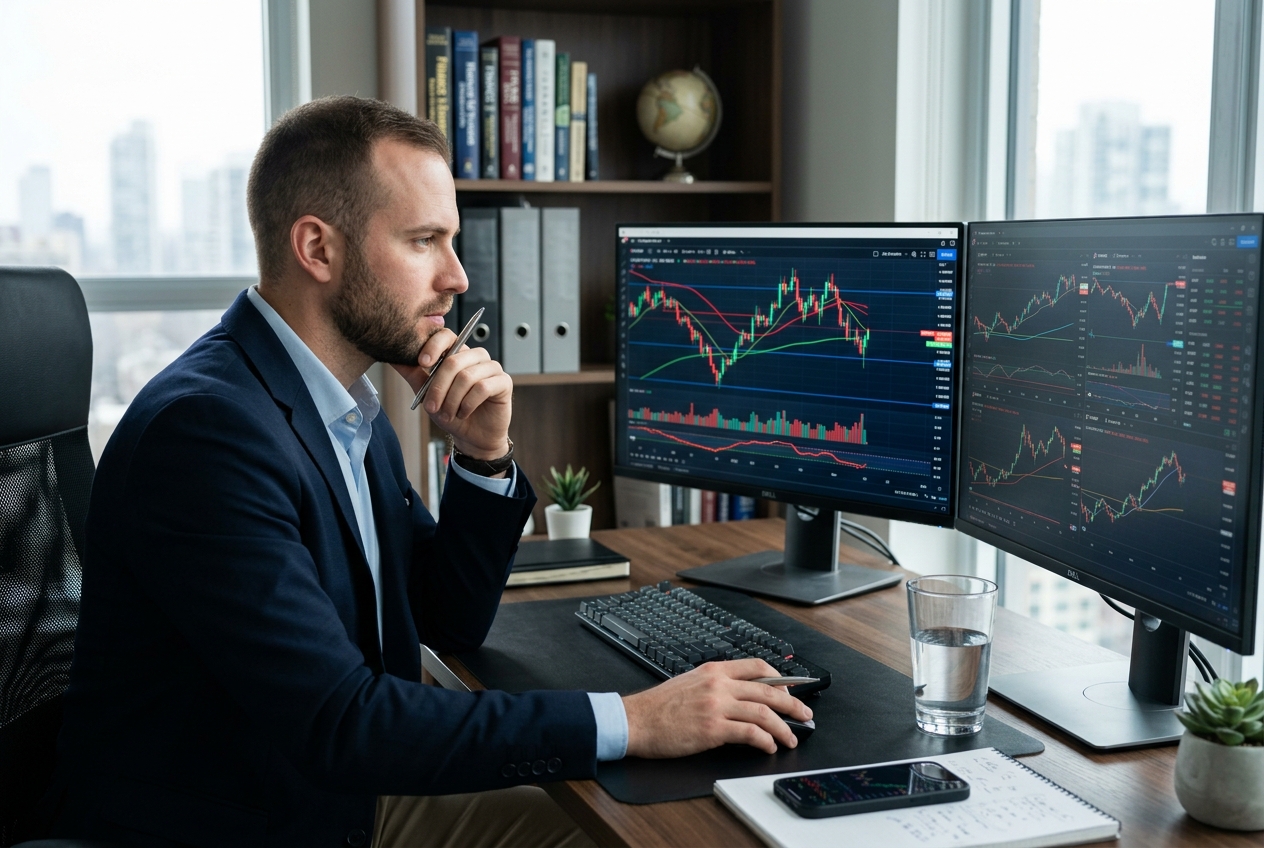
Is Forex Trading Gambling or a Real Business Opportunity?
Every year, millions of new participants enter the foreign exchange market with the hope of generating consistent income, yet a significant number of them exit within months, their accounts depleted. The question of whether forex trading is gambling or a legitimate business opportunity remains one of the most debated topics in personal finance. The answer, as with most things involving money and risk, depends almost entirely on the individual behind the screen. A disciplined professional who treats forex as an enterprise will experience something fundamentally different from someone placing impulsive trades based on gut feelings. The distinction between the two is not found in the market itself but in the approach, preparation, and mindset each person brings to the table. Understanding where speculation ends and gambling begins is essential for anyone serious about building long-term wealth through currency markets. This article draws that line clearly, examining the structural, psychological, and operational factors that separate professional forex trading from a trip to the casino.
Defining the Thin Line Between Speculation and Gambling
The forex market processes over $7.5 trillion in daily volume, making it the largest and most liquid financial market on the planet. Institutional banks, hedge funds, central banks, and multinational corporations all participate in this market for hedging, investment, and commerce. The sheer scale and sophistication of these participants suggest that currency trading is far more than a game of chance. Yet the same market that serves as a professional arena for institutions can function as a virtual slot machine for an unprepared retail trader.
The difference between speculation and gambling lies in the presence or absence of an edge. A speculator identifies repeatable patterns, quantifies risk, and accepts that losses are a cost of doing business. A gambler, on the other hand, relies on hope, hunches, and the thrill of the outcome. Both face uncertainty, but only one has a structured framework for managing it.
The Role of Probability vs. Pure Luck
Professional traders think in probabilities, not certainties. A trading strategy with a 55% win rate and a 1:2 risk-to-reward ratio does not guarantee profit on any single trade, but over 200 trades, the mathematical expectation is positive. This probabilistic framework is what separates informed speculation from random betting. The casino always has a house edge, and over time, the gambler always loses. A trader with a tested edge, however, becomes the house.
Consider a coin toss. Each flip is random, and predicting the next outcome is impossible. Forex trading, by contrast, involves price movements driven by interest rate differentials, economic data releases, geopolitical events, and institutional order flow. These factors create patterns that skilled analysts can identify and exploit. The randomness is not total; it is conditional, and that conditionality is where the professional finds opportunity.
Luck still plays a role in any individual trade. A perfectly analyzed setup can fail because of an unexpected central bank intervention or a geopolitical crisis. The professional accepts this variance and sizes positions accordingly. The gambler, however, confuses a lucky streak with skill and increases exposure recklessly.
Psychological Traps: The Gambler’s Fallacy in Trading
One of the most dangerous cognitive biases in trading is the gambler’s fallacy: the belief that past outcomes influence future probabilities in independent events. A trader who has lost five consecutive trades might feel certain that the next one must be a winner. This reasoning is flawed and can lead to oversized positions, revenge trading, and catastrophic drawdowns.
Revenge trading is a particularly destructive pattern. After a loss, the emotional impulse is to recover the money immediately by taking a larger, often poorly analyzed trade. This behavior mirrors the casino gambler who doubles down after a losing hand, hoping to break even. The result is almost always a deeper hole.
The overconfidence trap operates in the opposite direction. After a series of winning trades, a trader may begin to believe they cannot lose. They abandon their risk parameters, increase position sizes beyond what their account can sustain, and eventually suffer a devastating loss. Are you following your trading plan, or are you following your emotions? That single question often determines whether your forex activity resembles a business or a bet.
Foundations of Forex as a Legitimate Business
Any legitimate business requires a product, a market, a strategy, and a system for managing finances. Forex trading meets all of these criteria when approached correctly. The product is risk itself: the trader buys and sells exposure to currency fluctuations. The market is the global interbank network. The strategy is the trader’s methodology for identifying high-probability setups. And the financial management system is the risk management framework that preserves capital through inevitable losing periods.
Treating forex as a business also means tracking performance metrics. Professional traders maintain detailed journals that record entry and exit prices, the rationale behind each trade, the emotional state at the time of execution, and the outcome. This data becomes the foundation for continuous improvement, much like a retailer analyzes sales figures to refine inventory decisions.
Market Analysis: Technical and Fundamental Pillars
Two primary schools of analysis drive professional forex decision-making. Technical analysis examines historical price data, chart patterns, and indicators to forecast future price movements. Fundamental analysis evaluates macroeconomic factors such as GDP growth, inflation rates, employment data, and central bank monetary policy.
A technical trader might identify a support level on the EUR/USD daily chart where price has bounced three times over the past six months. They place a buy order near that level with a stop-loss just below it, calculating their risk in advance. A fundamental trader, meanwhile, might go long on the Australian dollar after the Reserve Bank of Australia signals a hawkish shift in interest rate policy, anticipating capital inflows into AUD-denominated assets.
The most effective professionals combine both approaches. They use fundamental analysis to determine directional bias and technical analysis to time entries and exits. This dual framework provides a structured, evidence-based methodology that has nothing in common with rolling dice.
The Importance of a Trading Plan and Strategy
A trading plan is the business plan of a forex enterprise. It defines the markets you will trade, the timeframes you will analyze, the setups you will take, the risk you will allocate per trade, and the conditions under which you will stop trading for the day or week. Without this document, every trade becomes an improvisation, and improvisation in financial markets is gambling by another name.
Your strategy should be backtested across multiple market conditions. A system that performs well during trending markets but fails during consolidation needs rules for identifying the current market environment. Backtesting across at least 200 to 500 historical trades provides a statistically meaningful sample size for evaluating expectancy.
Forward testing on a demo account or a micro account is the next step. This phase bridges the gap between historical data and live execution, revealing issues like slippage, spread widening during news events, and the psychological pressure of real capital at risk.
Risk Management: The Professional’s Safety Net
Risk management is not a supplementary skill in forex trading; it is the primary skill. A trader can have a mediocre strategy and still survive, even profit, with exceptional risk management. Conversely, a brilliant analyst with poor risk controls will eventually blow up their account. The math is unforgiving: a 50% loss requires a 100% gain just to break even.
Professional trading firms enforce strict drawdown limits on their traders, typically capping daily losses at 2% to 5% of the account and maximum drawdowns at 8% to 12%. These are not arbitrary obstacles. They are institutional risk management principles designed to ensure the firm survives long enough for its edge to play out over hundreds of trades.
Capital Preservation and Position Sizing
The first rule of professional trading is to protect your capital. You cannot trade without it, and replacing lost capital is far more difficult than preserving what you already have. Most professionals risk between 0.5% and 2% of their account on any single trade. This means that even a string of ten consecutive losses, while painful, reduces the account by only 5% to 20% rather than wiping it out entirely.
Position sizing is the mechanical process of determining how many lots or units to trade based on your account size, the distance to your stop-loss, and your predetermined risk percentage. For example, if you have a $50,000 account and risk 1% per trade with a 50-pip stop-loss on EUR/USD, your position size would be approximately one standard lot. This calculation removes emotion from the equation and enforces discipline.
Fixed fractional position sizing ensures that as your account grows, your position sizes grow proportionally, and as your account shrinks, your exposure decreases automatically. This self-correcting mechanism is one of the most powerful tools a trader can employ.
Leverage: A Tool for Growth or a Path to Ruin
Leverage is a double-edged sword that amplifies both gains and losses. A 100:1 leverage ratio means that a 1% move against your position wipes out your entire margin. Regulated brokers in the European Union cap retail leverage at 30:1 for major currency pairs, while brokers in other jurisdictions may offer 500:1 or higher.
The professional views leverage as a tool for capital efficiency, not a mechanism for outsized bets. Using 10:1 or 20:1 effective leverage while maintaining strict position sizing rules is a responsible approach. Using 200:1 leverage on a single trade because you feel confident about the direction is gambling with extra steps.
Ask yourself honestly: do you calculate your effective leverage before entering each trade? If the answer is no, you are likely taking on far more risk than you realize. A margin call does not care about your analysis or your conviction.
The Infrastructure of a Forex Enterprise
Running forex as a business requires infrastructure beyond a laptop and an internet connection. Professional traders invest in their tools, their education, and their legal standing, just as any business owner would invest in equipment, training, and compliance.
Operating Costs, Software, and Data Feeds
Your operating costs as a forex trader include spreads, commissions, platform subscriptions, data feed services, and potentially VPS (Virtual Private Server) hosting for algorithmic strategies. Spreads on EUR/USD can range from 0.1 pips during peak London session liquidity to 2 pips or more during the Asian session’s quieter hours. Over hundreds of trades, these costs compound significantly.
Professional-grade charting software like TradingView Pro or Bloomberg Terminal provides access to institutional-level data and analysis tools. A reliable data feed ensures that your technical analysis is based on accurate price information rather than delayed or filtered quotes. These are not optional luxuries; they are the cost of doing business in a competitive market.
A VPS ensures that automated trading systems execute without interruption, even if your home internet connection fails. For discretionary traders, a backup internet source and a mobile trading app serve a similar purpose. Downtime during a volatile market event can turn a winning position into a devastating loss.
Legal Compliance and Choosing Regulated Brokers
Choosing a regulated broker is not a preference; it is a requirement for anyone treating forex as a legitimate enterprise. Regulated brokers operating under the FCA (United Kingdom), ASIC (Australia), CySEC (Cyprus), or CFTC (United States) must segregate client funds, maintain minimum capital requirements, and submit to regular audits. These protections exist because unregulated brokers have a long history of manipulating prices, delaying withdrawals, and disappearing with client deposits.
Tax obligations also apply. In most jurisdictions, forex profits are taxable, and maintaining accurate records of every trade is essential for compliance. A professional trader treats tax planning as part of their business operations, not as an afterthought during filing season.
Why Most Beginners Treat Forex Like a Casino
The retail forex industry has a well-documented failure rate. Various studies suggest that between 70% and 80% of retail traders lose money. This statistic fuels the perception that forex trading is just gambling dressed in financial terminology. But the statistic reflects the behavior of the participants, not the nature of the market itself.
The Impact of Emotional Decision Making
Emotional decision-making is the single greatest destroyer of trading accounts. Fear causes traders to exit winning positions too early, locking in small gains while letting losses run. Greed pushes traders to hold losing positions, hoping for a reversal that never comes. Both behaviors violate basic risk management principles and erode account equity over time.
The concept of cognitive bandwidth is relevant here. A trader who is stressed about bills, distracted by personal problems, or sleep-deprived does not have the analytical objectivity required for sound decision-making. Professional traders recognize that their mental state is a variable in their performance and take steps to protect it, including setting daily loss limits that trigger a mandatory break from the screens.
Lack of Education and the ‘Get Rich Quick’ Myth
Social media is flooded with images of young traders posing with luxury cars and stacks of cash, implying that forex profits come quickly and easily. This narrative attracts people who have no interest in studying market structure, practicing on demo accounts, or developing a tested strategy. They deposit money, place random trades with maximum leverage, and lose everything within weeks.
The reality is that becoming a consistently profitable trader typically requires one to three years of dedicated study and practice. A graduated transition strategy works best: start with a demo account, move to a nano or cent account with minimal real capital, and only scale up after demonstrating consistent profitability over at least six months. This approach bridges the psychological gap between simulated and live trading without risking significant financial damage.
Is forex trading gambling for these individuals? Functionally, yes. But the market did not make them gamble. Their lack of preparation did.
Transitioning from a Hobbyist to a Professional Trader
The shift from hobbyist to professional is not marked by a specific account size or a particular win rate. It is marked by a change in identity and process. A professional trader has a written trading plan, a risk management framework, a performance journal, and a schedule that aligns with the most liquid trading sessions for their chosen pairs. The London session, for example, accounts for roughly 35% of daily forex volume and offers the tightest spreads on European and cross-currency pairs.
Professionals also understand the mathematics of realistic returns. A 3% monthly return on a $200,000 funded account generates $6,000 per month. Achieving that same $6,000 from a $10,000 personal account would require a 60% monthly return, a figure that demands reckless risk-taking and is unsustainable over any meaningful period. This is why many aspiring professionals pursue funded trading accounts through proprietary firms, where they trade the firm’s capital in exchange for a profit split.
Your trading schedule should align with your personal time zone and lifestyle. A sustainable trading routine prevents burnout and ensures that you are consistently present during the market conditions that your strategy targets. Trading every session, chasing every move, and staring at charts for twelve hours a day is not professionalism. It is a recipe for exhaustion and poor decisions.
The question of whether forex is gambling or a real business has a clear answer: it is whatever you make it. If you treat it with the same rigor, discipline, and respect you would give any serious enterprise, it can generate consistent income over time. If you approach it without a plan, without education, and without risk controls, you are simply placing bets with extra steps. The market does not decide which category you fall into. You do. Start by building the infrastructure, developing the skills, and committing to the process, and you will find that forex trading has far more in common with running a business than visiting a casino.