
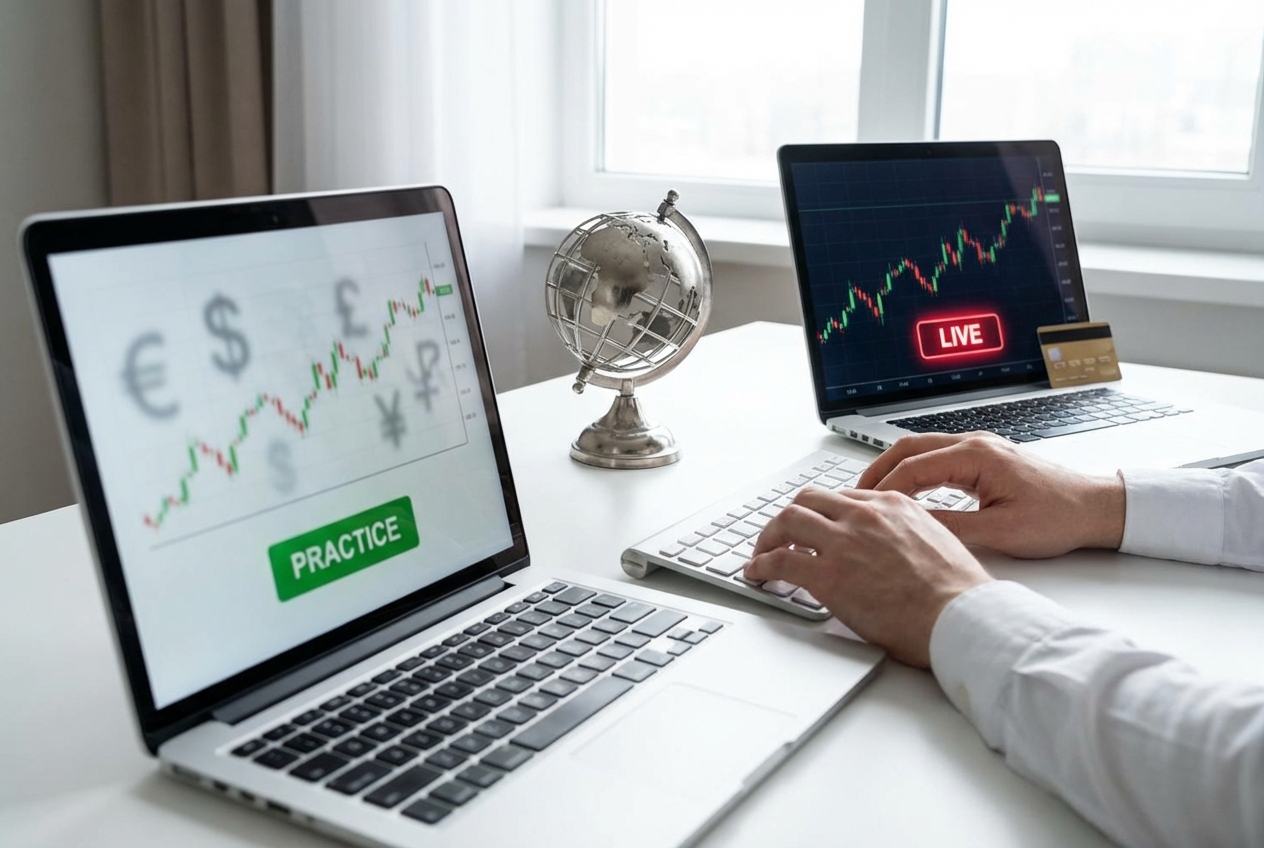
Forex Demo vs. Live Accounts: When to Make the Switch
Every trader reaches a crossroads where the comfortable safety of demo trading begins to feel restrictive, yet the prospect of risking real capital triggers genuine apprehension. The decision to transition from a forex demo to a live account represents one of the most significant milestones in a trader’s development, and getting the timing right can mean the difference between a sustainable trading career and a costly lesson in premature confidence.
Many traders rush this transition, seduced by a string of profitable demo trades, only to discover that real money introduces psychological variables they never anticipated. Others remain trapped in demo limbo indefinitely, perfecting strategies that never face the ultimate test of genuine market conditions. Understanding when you are genuinely prepared to make the switch requires honest self-assessment, measurable criteria, and a structured approach that acknowledges both the value and limitations of practice trading. The goal is to match you with the right moment for this transition, one where your skills, psychology, and risk management align to give you the best possible foundation for live trading success.
The Purpose and Limitations of Demo Trading
Demo accounts serve as essential training grounds where aspiring traders can develop their skills without financial consequences, but recognizing their inherent limitations is equally important for realistic expectations. These simulated environments provide invaluable exposure to market dynamics, platform functionality, and strategy testing, yet they cannot replicate every aspect of live trading conditions. Understanding what demo accounts do well and where they fall short helps traders extract maximum value from the practice phase while preparing mentally for the differences they will encounter once real money enters the equation.
Mastering Platform Mechanics and Tools
Your trading platform is your primary interface with the forex market, and demo accounts provide the perfect sandbox for achieving complete familiarity with every feature and function. Spending time in a demo environment allows you to practice order entry, experiment with different chart configurations, and understand how various technical indicators display information on your specific platform. You can test market orders, limit orders, stop-loss placements, and trailing stops without worrying about costly mistakes caused by clicking the wrong button or misunderstanding how a particular feature operates.
The mechanical aspects of trading, such as adjusting position sizes, modifying existing orders, and navigating between different timeframes, should become second nature before you risk real capital. Many traders underestimate how much cognitive bandwidth these basic operations consume when they are not yet automatic, leaving less mental capacity for actual market analysis and decision-making. A demo account allows you to make these processes instinctive, so when you transition to live trading, your focus remains on the market rather than on fumbling with platform controls.
The Absence of Price Slippage
One significant limitation of demo trading involves the execution quality you experience, which often differs substantially from live market conditions. Demo accounts typically fill orders at the exact price displayed on your screen, creating an unrealistic expectation of execution precision that rarely exists in actual trading. Live markets, particularly during high-volatility periods or around major news releases, frequently exhibit slippage where your order fills at a different price than requested.
This discrepancy can affect both entries and exits, potentially turning what appeared to be a profitable strategy in demo conditions into a marginal or losing approach under real market dynamics. Spreads may also widen during volatile periods in live accounts, another factor that demo environments often fail to simulate accurately. Traders who achieve consistent profitability in demo conditions should factor in additional costs from slippage and spread variations when projecting their potential live trading results.
Testing Strategies in a Demo Account
Strategy development and refinement represent perhaps the most valuable application of demo trading time. You can test different approaches, experiment with various entry and exit criteria, and evaluate how different market conditions affect your chosen methodology without risking capital during the learning process. This experimental freedom allows you to discover what resonates with your personality and schedule while building confidence in your analytical abilities.
However, the absence of financial consequences during strategy testing creates a subtle but important limitation. Trades that would cause significant emotional distress with real money produce no psychological response in a demo environment, meaning you cannot accurately assess how you will execute your strategy under genuine pressure. The strategy itself may prove sound, but your ability to follow it consistently when actual losses accumulate remains untested until you trade live.
The Gap Between Demo Trading vs Live Accounts
The transition from simulated to real trading introduces psychological variables that fundamentally alter the trading experience, and many traders find themselves surprised by how differently they behave when real money is at stake. Technical skills that seemed solid in demo conditions may falter under emotional pressure, and strategies that produced consistent results can suddenly feel impossible to execute correctly. Understanding this psychological gap before you encounter it helps you prepare for the mental challenges that accompany live trading.
Managing Fear and Greed on a Live Account
Fear and greed represent the two primary emotional forces that disrupt trading performance, and neither emotion fully manifests until real money enters the equation. Fear can cause you to exit profitable trades prematurely, avoid taking valid setups, or move stop-losses to avoid being stopped out, all behaviors that undermine your strategy’s expected performance. Greed may push you to overtrade, increase position sizes beyond your risk parameters, or hold losing trades hoping for recovery rather than accepting small losses.
These emotional responses operate largely below conscious awareness, making them particularly dangerous for traders who have never experienced them in a live context. You may intellectually understand that you should let winners run and cut losers short, but the visceral experience of watching real money fluctuate triggers primitive responses that bypass rational analysis. Developing emotional resilience requires actual exposure to these feelings, which is why some live trading experience, even with minimal capital, provides essential psychological training that demo accounts simply cannot offer.
The Impact of Emotional Detachment on Decision Making
Demo trading encourages a form of emotional detachment that actually improves decision-making quality, but this same detachment becomes impossible to maintain once real capital is involved. Without genuine stakes, you can analyze setups objectively, follow your rules consistently, and accept losses as normal trading costs without any emotional reaction. This optimal mental state produces excellent trading results, but it exists precisely because nothing real is at risk.
The challenge lies in recreating this detached, process-focused mindset while simultaneously caring about the financial outcomes of your trades. Experienced traders develop this ability over time, learning to separate their emotional response to individual trades from their longer-term assessment of strategy performance. New live traders, however, must consciously work to maintain analytical objectivity while their nervous system reacts to every tick of profit or loss. This is how to minimize the psychological gap: recognize that emotional responses are normal, expect them, and develop specific techniques for managing them rather than pretending they will not occur.
Key Indicators You Are Ready for a Live Account
Determining readiness for live trading requires objective criteria rather than subjective feelings of confidence or impatience. Many traders feel ready long before they have demonstrated the consistent performance and disciplined behavior that predict live trading success. Establishing specific benchmarks helps remove emotion from this important decision and ensures you transition only when your track record supports the move.
Consistent Profitability Over a Significant Sample Size
A handful of profitable demo trades proves nothing about your trading ability, as random chance can easily produce short winning streaks even with a fundamentally flawed approach. Meaningful assessment requires a sample size large enough to smooth out statistical noise and reveal the true characteristics of your trading methodology. Most trading educators recommend a minimum of 100 trades executed according to your strategy rules before drawing conclusions about profitability.
Beyond the raw number of trades, consistency matters more than total profit. A trader who earns steady small gains across most weeks demonstrates more genuine skill than one who accumulates the same total profit through a few large winners and numerous losses. Examine your equity curve for smooth upward progression rather than dramatic swings, as volatile demo results typically become even more volatile under the psychological pressure of live trading.
Strict Adherence to a Proven Trading Plan
Profitability means little if it results from impulsive decisions rather than systematic plan execution. Your demo trading phase should include detailed documentation of your trading plan, including entry criteria, exit rules, position sizing formulas, and risk parameters. Every trade you take should align with this written plan, and you should be able to justify each decision by pointing to specific plan elements that triggered your action.
Review your trade journal to assess compliance honestly. Did you take trades that fell outside your defined criteria? Did you exit positions for reasons not specified in your plan? Did you adjust position sizes based on recent results rather than following your predetermined formula? High plan adherence during demo trading suggests you have developed the discipline necessary for live trading, while frequent deviations indicate you need more practice following rules before introducing real money.
Developing a Disciplined Risk Management Routine
Risk management represents the foundation of trading longevity, and your demo trading should demonstrate consistent application of sound risk principles. This means risking a predetermined percentage of your account on each trade, typically between one and two percent for new traders, and never exceeding this limit regardless of how confident you feel about a particular setup. Your demo results should show that no single loss significantly damaged your account and that losing streaks, which inevitably occur, remained within tolerable bounds.
Position sizing calculations should become automatic, performed before every trade without exception. You should know your maximum loss before entering any position and accept that amount as an acceptable cost of testing your trading thesis. If your demo trading shows instances where you risked more than planned, held losing positions beyond your stop-loss level, or averaged down into losing trades, these behaviors require correction before you transition to live trading.
Steps for a Smooth Transition to a Live Account
The actual transition from demo to live trading benefits from a graduated approach rather than an abrupt switch from simulated trading to full position sizes. Starting with minimal real capital allows you to experience the psychological differences between demo and live trading while limiting the financial cost of the inevitable adjustment period. This measured approach helps preserve both your trading capital and your confidence during the learning curve.
Starting Small with Micro or Nano Lots
Micro lots, representing 1,000 units of currency, and nano lots, representing 100 units, allow you to trade with real money while keeping individual trade risk extremely small. A one percent move against a micro lot position in most currency pairs produces a loss of approximately ten dollars, small enough to be financially insignificant while still generating genuine emotional responses. This position sizing creates a training environment where you experience real trading psychology without risking substantial capital.
Many traders resist starting this small, feeling that tiny position sizes make trading pointless or that their demo success entitles them to larger positions immediately. This resistance itself reveals the ego involvement that makes live trading psychologically challenging. Accepting small position sizes demonstrates the humility and patience that characterize successful traders, while rushing to larger sizes often reflects the overconfidence that precedes significant losses.
Bridging the Gap with Cent Accounts
Some brokers offer cent accounts where your balance displays in cents rather than dollars, allowing you to deposit a small amount and trade what appears to be a larger account. A one hundred dollar deposit shows as 10,000 cents, and standard lot sizes become accessible while actual risk remains minimal. These accounts provide another option for traders seeking to experience live market conditions with reduced financial exposure.
Cent accounts offer psychological benefits by making account balances and profit/loss figures feel more significant than the actual dollar amounts involved. This perception can help traders take the experience seriously while the genuine financial risk stays low. However, traders should remain aware that the emotional intensity of cent account trading still falls short of trading meaningful capital, so this approach represents an intermediate step rather than a final destination.
Common Pitfalls to Avoid After Going Live
The weeks and months following your transition to live trading present specific challenges that have derailed countless trading careers. Awareness of these common pitfalls helps you recognize problematic patterns in your own behavior before they cause serious damage. Most of these issues stem from emotional reactions to early trading results, whether those results are positive or negative.
Overtrading Due to Initial Success or Loss
Early success in live trading can prove surprisingly dangerous, as it often triggers overconfidence that leads to increased position sizes, more frequent trading, or relaxed adherence to strategy rules. The assumption that live trading will be easy, based on a small sample of winning trades, sets traders up for devastating losses when the inevitable losing streak arrives. Maintaining your predetermined risk parameters regardless of recent results protects against this overconfidence trap.
Initial losses present the opposite but equally dangerous temptation. Traders who experience early live losses often increase their trading frequency or position sizes in an attempt to recover quickly, a behavior pattern known as revenge trading. This emotional response typically accelerates losses rather than recovering them, as decisions made from frustration rarely align with sound strategy. Accepting that early losses are normal and maintaining your planned approach despite them demonstrates the emotional resilience that live trading requires.
Deviating from Strategy Under Pressure
The psychological pressure of live trading frequently causes traders to abandon the very strategies that produced their demo success. Entries that looked obvious in demo conditions suddenly seem risky with real money involved, leading to hesitation and missed opportunities. Stop-losses that seemed reasonable during planning feel impossibly tight when actual capital is at stake, tempting traders to widen them or remove them entirely. Profit targets that appeared conservative now seem greedy, causing premature exits that capture only a fraction of available gains.
These deviations typically occur unconsciously, with traders rationalizing each decision as a reasonable response to specific market conditions rather than recognizing the pattern of fear-driven behavior. Maintaining detailed trade journals during your early live trading helps identify these patterns by comparing your actual behavior to your planned strategy. When discrepancies appear, honest assessment of whether the deviation reflected genuine market insight or emotional reaction helps you correct course before bad habits become ingrained.
Long-Term Success: Balancing Live Trading and Continued Learning
The transition from demo to live trading does not mark the end of your development as a trader but rather the beginning of a more intensive learning phase. Live trading provides feedback that demo trading cannot, revealing aspects of your psychology and strategy that only become apparent under real market conditions. Treating your early live trading as an extension of your education, rather than a pure profit-seeking endeavor, helps maintain realistic expectations and supports continued improvement.
Successful traders never stop learning, refining their approaches based on market feedback and evolving conditions. Your demo account remains a valuable tool even after you begin live trading, providing a risk-free environment for testing strategy modifications or exploring new approaches before implementing them with real capital. The skills you developed during demo trading, including platform proficiency, strategy testing methodology, and analytical discipline, continue serving you throughout your trading career.
The decision to switch from demo to live trading ultimately comes down to honest self-assessment against objective criteria. When you have demonstrated consistent profitability over a meaningful sample size, strict adherence to a documented trading plan, and disciplined risk management across various market conditions, you have established the foundation for live trading success. Starting with minimal position sizes allows you to bridge the psychological gap between simulated and real trading while protecting your capital during the adjustment period. Let’s get started: if your demo results meet these benchmarks and you have accepted that live trading will feel different despite your preparation, you are ready to take the next step in your trading journey.