
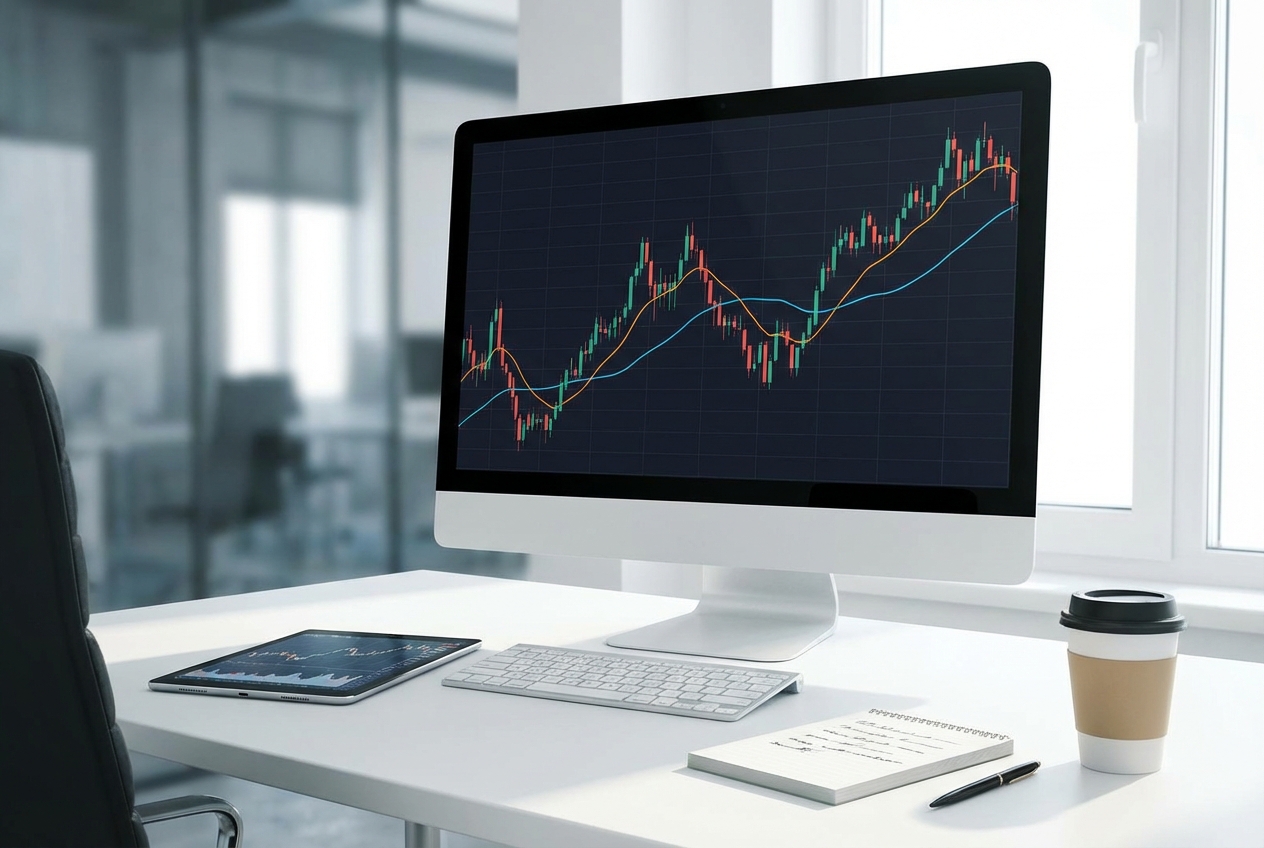
What Is a Moving Average and How Does It Work?
A single price point on a chart tells you almost nothing about where a stock, currency, or commodity might head next. Yesterday's closing price could represent the start of a major trend, a temporary blip caused by low trading volume, or simply random noise in an otherwise stable market. Traders and investors who want to understand the broader direction of price movement need a tool that filters out this day-to-day volatility and reveals the underlying pattern beneath the chaos. This is precisely where moving averages become indispensable.
Understanding what a moving average is and how it works forms the foundation of technical analysis for millions of market participants worldwide. At its core, a moving average takes a series of prices over a defined period and calculates their average, then "moves" forward as each new data point arrives. The result is a smoothed line that trails behind actual price action, helping you identify whether prices are generally rising, falling, or moving sideways. Whether you are a day trader scanning for quick opportunities or a long-term investor trying to time your entry into a position, mastering this concept will sharpen your ability to read markets with greater clarity.
Defining the Moving Average in Trading
The Core Concept of Smoothing Price Data
Price charts without any overlays can appear chaotic, with sharp spikes and sudden drops that make trend identification difficult. A moving average addresses this problem by calculating the mean price over a specific number of periods, whether those periods represent minutes, hours, days, or weeks. Each time a new period closes, the oldest data point drops out of the calculation while the newest one enters, causing the average to shift or "move" along with current market conditions.
Consider a ten-day simple moving average on a stock chart. On day eleven, the calculation drops day one's price and incorporates day eleven's closing price, producing a new average that reflects the most recent ten-day window. This continuous recalculation creates a flowing line that smooths out temporary price fluctuations. You can observe the general direction of this line to determine whether buyers or sellers have maintained control over the specified timeframe.
The smoothing effect becomes more pronounced as you increase the number of periods in your calculation. A 200-day moving average, for instance, responds very slowly to recent price changes because each new day represents only a tiny fraction of the total data set. Conversely, a five-day moving average reacts quickly to new information, hugging price action more closely but also producing more false signals during choppy markets.
Lagging Indicators vs. Leading Indicators
Technical analysts categorize their tools into two broad groups based on timing characteristics. Leading indicators attempt to predict future price movements before they occur, often by measuring momentum or market sentiment. Lagging indicators, by contrast, confirm trends that have already begun rather than forecasting what might happen next. Moving averages fall squarely into the lagging category because their calculations rely entirely on historical price data.
This lagging nature carries both advantages and disadvantages for your trading approach. On the positive side, lagging indicators help you avoid acting on false signals that might occur during brief price reversals. By waiting for the moving average to confirm a trend change, you reduce the risk of entering positions based on temporary market noise. The tradeoff is that you will never catch the exact top or bottom of any move, since confirmation requires some price history to accumulate first.
Understanding this distinction helps you set realistic expectations for how moving averages function within your strategy. They excel at keeping you aligned with established trends and filtering out distracting fluctuations, but they cannot tell you when a trend is about to reverse before it actually does. Successful traders often combine moving averages with leading indicators to balance confirmation with anticipation.
Common Types of Moving Averages
Simple Moving Average (SMA)
The simple moving average represents the most straightforward version of this indicator. You calculate it by adding up the closing prices for a specified number of periods and dividing by that same number. A 20-day SMA, for example, sums the last twenty closing prices and divides by twenty, producing a single value that you plot on your chart.
This equal weighting of all data points within the lookback period makes the SMA easy to understand and calculate. Every price in the series carries identical importance regardless of when it occurred. A closing price from twenty days ago contributes exactly as much to the final average as yesterday's close. Many traders appreciate this simplicity because it provides a clear, unmanipulated view of average price over time.
The primary criticism of simple moving averages centers on their slow response to sudden price changes. Because old data carries equal weight to new data, significant recent moves take time to substantially shift the average. During fast-moving markets or around major news events, the SMA may lag considerably behind actual price action.
Exponential Moving Average (EMA)
The exponential moving average addresses the responsiveness issue by assigning greater weight to recent prices. Rather than treating all data points equally, the EMA applies a multiplier that emphasizes the most current information while still incorporating older prices at diminishing rates. This mathematical approach allows the indicator to react more quickly when market conditions change.
Calculating an EMA involves first determining a smoothing factor based on your chosen period length. This multiplier is then applied to each new closing price, with the previous EMA value carrying forward at a reduced weight. The result is a moving average that tracks current price action more closely than its simple counterpart while still providing meaningful smoothing.
Traders who focus on shorter timeframes or volatile instruments often prefer exponential moving averages because they capture trend changes sooner. However, this increased sensitivity also means the EMA generates more false signals during ranging or choppy markets. Your choice between SMA and EMA should reflect your trading style, timeframe, and tolerance for signal noise.
Weighted Moving Average (WMA)
The weighted moving average takes a middle path between the equal treatment of the SMA and the exponential decay of the EMA. With a WMA, you assign specific numerical weights to each price in the series, typically giving the most recent price the highest weight and decreasing linearly as you move backward through time.
For a five-period WMA, you might multiply the most recent price by five, the second most recent by four, and so on down to the oldest price multiplied by one. You then sum these weighted values and divide by the total of all weights. This approach provides direct control over exactly how much emphasis each data point receives in the final calculation.
While less popular than SMAs and EMAs in mainstream trading platforms, weighted moving averages offer flexibility for analysts who want precise control over their indicator's sensitivity. Some trading systems use custom weighting schemes tailored to specific market behaviors or asset classes.
How Moving Averages Are Calculated
Selecting the Right Time Period
The number of periods you choose for your moving average dramatically affects its behavior and the signals it generates. Shorter periods create averages that respond quickly to price changes but produce more crossover signals, including many false ones. Longer periods generate smoother lines that filter out noise more effectively but confirm trend changes well after they begin.
Common period selections have emerged through decades of trader experimentation. The 50-day and 200-day moving averages dominate long-term analysis, while the 10-day and 20-day versions serve shorter-term traders. Intraday participants might use 9-period or 21-period averages on minute charts. These specific numbers often trace back to trading conventions, such as the roughly 200 trading days in a calendar year or the approximately 20 trading days in a month.
Your ideal period selection depends on your trading objectives and the characteristics of the instrument you are analyzing. Highly volatile assets may require longer periods to avoid excessive whipsawing, while stable instruments might work well with shorter settings. Testing different period lengths against historical data helps you identify configurations that match your strategy.
The Impact of Closing Prices
Most moving average calculations use closing prices rather than opening prices, highs, or lows. The closing price carries special significance because it represents the final consensus between buyers and sellers for that trading period. It reflects where market participants were willing to hold positions overnight or through the weekend, making it a meaningful summary of that period's activity.
Some analysts experiment with alternative price inputs such as the typical price, which averages the high, low, and close for each period. Others use the median price, calculated as the midpoint between high and low. These variations can produce slightly different moving average lines that may better suit specific analytical purposes.
Regardless of which price input you select, consistency matters more than the specific choice. Switching between closing prices and typical prices mid-analysis introduces inconsistencies that can distort your interpretation. Establish your methodology and apply it uniformly across your charts and backtesting.
Practical Applications in Trading and Investing
Identifying Market Trends
The most fundamental application of moving averages involves determining the prevailing trend direction. When price trades above its moving average, the market exhibits bullish characteristics with buyers maintaining control. When price falls below the moving average, bearish conditions dominate as sellers drive the action. This simple framework helps you align your positions with the broader market direction rather than fighting against it.
Trend identification becomes more reliable when you observe how price interacts with the moving average over time. A healthy uptrend typically features price remaining above the average with occasional pullbacks that find support at or near the moving average line. Downtrends show the opposite pattern, with price staying below the average and rallies failing at or near that level.
Multiple moving averages on the same chart provide additional confirmation. When a shorter-period average remains above a longer-period average, the overall trend structure supports bullish positioning. The reverse arrangement suggests bearish conditions. This layered approach reduces the likelihood of misreading temporary price fluctuations as trend changes.
Determining Support and Resistance Levels
Moving averages often function as dynamic support and resistance zones because so many traders watch and act upon them. The 50-day and 200-day moving averages, in particular, attract significant attention from institutional investors and algorithmic trading systems. When price approaches these levels, buying or selling pressure frequently emerges as market participants execute their predetermined strategies.
During uptrends, pullbacks to the moving average often attract buyers who view the dip as an opportunity to enter at favorable prices. This buying pressure can halt the decline and push price back upward, making the moving average function as support. The opposite occurs during downtrends, where rallies to the moving average encounter selling pressure that caps the advance.
You should treat these levels as zones rather than precise lines. Price may briefly penetrate a moving average before reversing, or it may reverse slightly before reaching it. Combining moving average analysis with other technical tools such as volume patterns or candlestick formations improves your ability to anticipate reactions at these important levels.
Spotting Golden Cross and Death Cross Signals
The golden cross occurs when a shorter-term moving average crosses above a longer-term moving average, signaling potential bullish momentum. The most widely followed version involves the 50-day moving average crossing above the 200-day moving average. This event attracts media attention and often triggers buying from traders who use this signal as an entry criterion.
The death cross represents the bearish counterpart, occurring when the shorter-term average crosses below the longer-term average. A 50-day moving average dropping below the 200-day moving average warns of potential extended weakness and may prompt traders to reduce exposure or initiate short positions.
These crossover signals carry significant weight because of their widespread recognition, but they are not infallible predictors. False signals occur regularly, particularly during ranging markets where price oscillates without establishing a clear trend. The lag inherent in moving averages means that by the time a golden cross or death cross appears, substantial price movement has already occurred.
Choosing the Best Moving Average for Your Strategy
Short-Term Trading vs. Long-Term Investing
Your time horizon should drive your moving average selection more than any other factor. Day traders and swing traders operating on timeframes measured in hours or days need responsive indicators that quickly reflect changing conditions. The 9-period and 21-period exponential moving averages serve this audience well, providing timely signals while still offering some smoothing benefit.
Position traders and investors with horizons measured in weeks or months require different tools. The 50-day and 200-day simple moving averages remain standards for this group because they filter out short-term noise and focus attention on significant trend changes. These longer averages generate fewer signals, but each signal carries greater weight and typically precedes more substantial price moves.
Matching your moving average parameters to your actual trading behavior prevents frustration and improves results. Using a 200-day moving average for day trading produces signals too slowly to be useful, while applying a 9-period average to long-term investing generates excessive noise that obscures meaningful trends.
Limitations and Risks of Relying on Averages
Moving averages work best in trending markets where price moves directionally for extended periods. During these conditions, the indicator keeps you positioned with the trend and helps you avoid premature exits. However, markets spend considerable time moving sideways in trading ranges where moving averages generate repeated false signals as price oscillates above and below the average line.
The lagging nature of all moving averages means you will always sacrifice some profit potential at trend reversals. By the time your moving average confirms that a downtrend has ended, price may have already risen substantially from its low. Similarly, exit signals arrive after price has declined from its peak. This is the unavoidable cost of using a confirmation-based tool rather than a predictive one.
Over-reliance on any single indicator creates blind spots in your analysis. Moving averages tell you nothing about volume patterns, market sentiment, fundamental valuations, or upcoming economic events. Building a comprehensive trading approach requires integrating moving averages with other analytical methods rather than treating them as standalone decision-making tools.
Putting Moving Averages to Work
The moving average stands as one of the most accessible and widely used tools in technical analysis precisely because it addresses a fundamental challenge every trader faces: distinguishing meaningful price trends from random market noise. By smoothing historical price data into a single flowing line, this indicator reveals the underlying direction of market movement and provides reference points for making informed trading decisions.
Your success with moving averages depends on selecting appropriate parameters for your timeframe, understanding the inherent lag in all moving average signals, and combining this tool with other forms of analysis. No indicator works perfectly in all market conditions, and moving averages are no exception. They excel during trending periods but struggle when price consolidates within ranges.
Let's get started with implementing moving averages in your own analysis. Begin by adding a 50-day and 200-day simple moving average to your charts and observing how price interacts with these levels over time. Notice where crossovers occur and track what happens in the days and weeks following these signals. This hands-on observation builds the intuition necessary to use moving averages effectively as part of a disciplined trading methodology.