
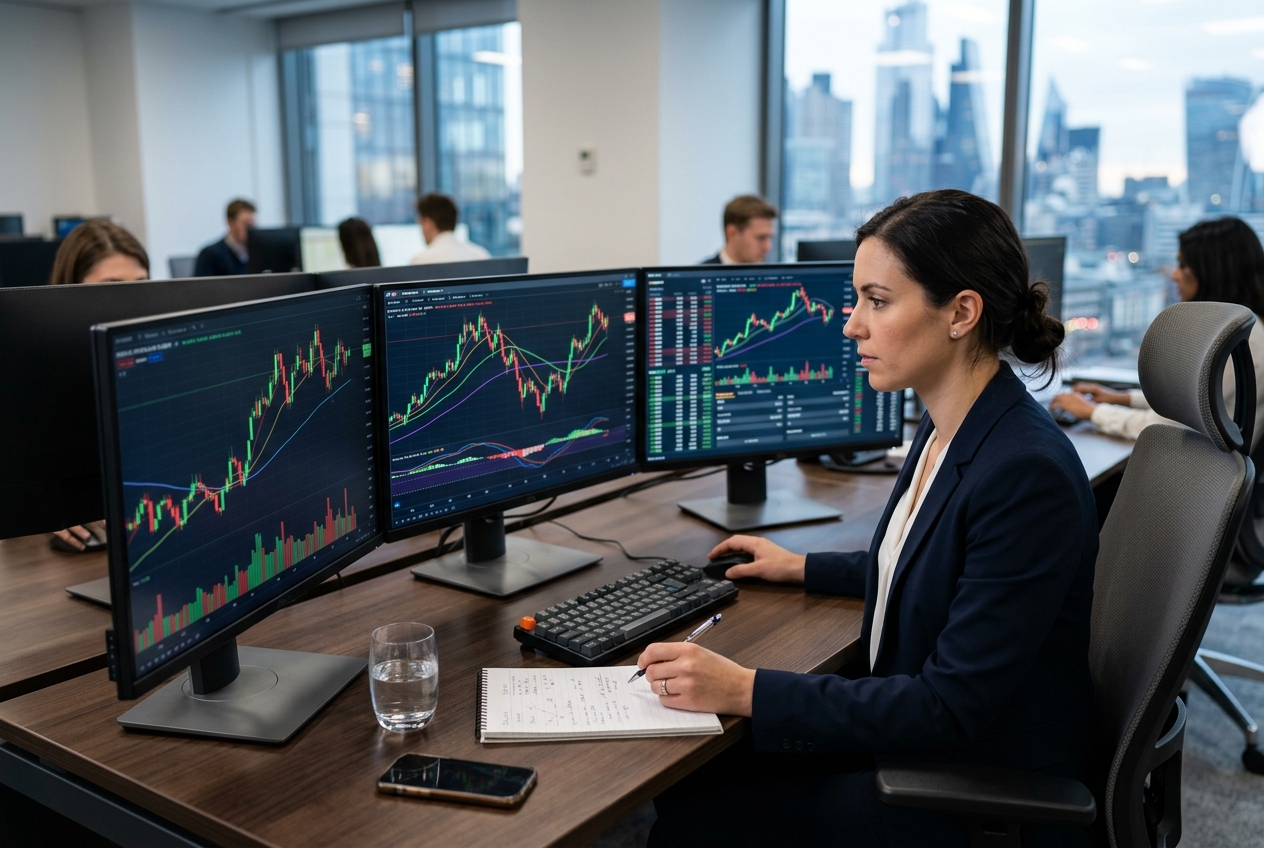
What You Need to Know Before You Start Forex Trading
The foreign exchange market processes over $7.5 trillion in daily volume, making it the largest and most liquid financial market on the planet. That sheer scale attracts everyone from central banks and multinational corporations to individual retail traders working from a laptop. Yet the majority of retail participants lose money in their first year, often because they skip the preparation phase entirely. Understanding what you need to know before starting forex trading is the difference between approaching this market as a professional discipline and treating it like a lottery ticket. This guide covers the foundational knowledge, risk awareness, broker selection criteria, strategy development, psychological readiness, and risk management protocols that form the bedrock of any serious trading career.
Understanding the Fundamentals of the Foreign Exchange Market
Forex trading is the simultaneous buying of one currency and selling of another. Unlike stock markets tied to a single exchange, the forex market operates as a decentralized, over-the-counter network connecting banks, institutions, and individual traders across the globe. Every transaction reflects a bet on the relative strength of one economy versus another, and prices shift constantly based on interest rate decisions, geopolitical events, and macroeconomic data releases.
Before you place a single trade, you need a firm grasp of how currencies are quoted, who moves the market, and when the best opportunities tend to appear. These three pillars form the structural knowledge that every other skill builds upon.
How Currency Pairs and Pips Work
Currencies always trade in pairs. The first currency listed is the base currency, and the second is the quote currency. If EUR/USD is quoted at 1.0850, that means one euro costs 1.0850 US dollars. When you buy EUR/USD, you are buying euros and simultaneously selling dollars.
A pip, short for “percentage in point,” is the smallest standard price movement in a currency pair. For most pairs, one pip equals 0.0001 of the quoted price. If EUR/USD moves from 1.0850 to 1.0855, that is a five-pip move. The Japanese yen is an exception: pairs involving the yen measure pips at the second decimal place, so a move from 150.20 to 150.25 in USD/JPY represents five pips.
Your profit or loss on any trade depends on the number of pips the price moves multiplied by your position size. A standard lot of 100,000 units means each pip in EUR/USD is worth roughly $10. A mini lot (10,000 units) makes each pip worth $1, and a micro lot (1,000 units) reduces that to $0.10. Grasping this math is essential before you risk real capital.
Market Participants: Central Banks to Retail Traders
The forex market is not a level playing field. Central banks sit at the top of the hierarchy, influencing currency values through monetary policy decisions and direct intervention. The Federal Reserve, European Central Bank, and Bank of Japan can move markets dramatically with a single interest rate announcement or policy statement.
Below central banks, large commercial and investment banks form the interbank market, where the bulk of daily volume occurs. These institutions trade on behalf of clients and for their own proprietary accounts, often dealing in positions worth hundreds of millions of dollars. Hedge funds and asset managers represent the next tier, frequently taking speculative positions based on macroeconomic research.
Retail traders account for a small fraction of total volume, typically estimated between 3% and 6%. This means you are trading alongside participants with vastly greater resources, information access, and execution speed. Recognizing your place in this hierarchy keeps expectations grounded and encourages a disciplined, methodical approach rather than reckless speculation.
The 24-Hour Trading Cycle and Major Sessions
The forex market operates 24 hours a day, five days a week, rotating through three major sessions: Tokyo (Asian), London (European), and New York (North American). Each session has distinct characteristics that affect volatility, spreads, and trading opportunities.
The London session accounts for roughly 35% of total daily volume and tends to produce the strongest directional moves in European currency pairs. The New York session overlaps with London for several hours, creating the most liquid and volatile window of the trading day. During this overlap, spreads on major pairs like EUR/USD can drop to as low as 0.1 pips. The Tokyo session is generally quieter, with tighter ranges and wider spreads on non-yen pairs, sometimes reaching 2 pips or more.
You should align your trading schedule with your personal time zone and lifestyle. If you live in Asia and prefer high volatility, you may need to trade during late evening hours to catch the London open. Building a sustainable trading routine matters more than forcing yourself into sessions that disrupt your sleep and cognitive bandwidth.
Assessing the Risks and Realities of Leverage
Leverage is the feature that makes forex accessible to retail traders with small accounts, but it is also the primary reason most of them fail. Before you fund a live account, you must understand exactly how margin and leverage amplify both gains and losses.
The Double-Edged Sword of Margin Trading
Leverage allows you to control a large position with a relatively small deposit, known as margin. A 50:1 leverage ratio means you can control $50,000 worth of currency with just $1,000 in your account. If the trade moves 1% in your favor, you earn $500, a 50% return on your margin. But if it moves 1% against you, you lose $500, half your deposit, in a single trade.
Margin calls occur when your account equity falls below the broker’s required maintenance level. At that point, the broker may automatically close your positions to prevent further losses, often at the worst possible price. This forced liquidation, combined with slippage during fast-moving markets, can result in losses that exceed your initial deposit with some brokers.
Many regulatory bodies have imposed leverage caps specifically to protect retail traders. The European Securities and Markets Authority limits retail forex leverage to 30:1 on major pairs, while Australian regulators enforce similar restrictions. These caps exist because data consistently shows that higher leverage correlates with higher loss rates among retail participants.
Managing Volatility and Market Liquidity
Volatility is the degree to which a currency pair’s price fluctuates over a given period. Some traders thrive on volatility because it creates profit opportunities. Others get destroyed by it because they fail to adjust their position sizes and stop-losses accordingly.
Liquidity refers to how easily you can enter or exit a position without significantly affecting the price. Major pairs like EUR/USD and USD/JPY are highly liquid, meaning tight spreads and minimal slippage during normal conditions. Exotic pairs such as USD/TRY or USD/ZAR carry much wider spreads and can experience sudden gaps during low-liquidity periods.
High-impact news events, including non-farm payrolls, central bank rate decisions, and geopolitical crises, can cause both volatility and liquidity to shift dramatically within seconds. Many professional risk management frameworks treat these events as restricted trading windows, and you should consider doing the same until you have enough experience to handle rapid price swings without emotional decision-making.
Choosing a Regulated and Reliable Forex Broker
Your broker is the gateway to the market, and choosing the wrong one can undermine even the best trading strategy. The goal is to match you with the right broker based on regulatory standing, cost structure, and platform quality.
Verifying Licenses and Regulatory Compliance
Regulation is the single most important factor in broker selection. A regulated broker must segregate client funds from company operating capital, submit to regular audits, and maintain minimum capital reserves. If the broker becomes insolvent, segregated funds provide a layer of protection for your deposits.
Look for brokers regulated by top-tier authorities:
- The Financial Conduct Authority (FCA) in the United Kingdom
- The Australian Securities and Investments Commission (ASIC)
- The Commodity Futures Trading Commission (CFTC) in the United States
- The Cyprus Securities and Exchange Commission (CySEC) within the European Union
Verify the broker’s license number directly on the regulator’s website. Some unscrupulous firms display fake license numbers or claim regulation they do not actually hold. A five-minute verification check can save you from depositing funds with an unregulated entity that has no legal obligation to return your money.
Evaluating Spreads, Commissions, and Fees
Trading costs directly eat into your profitability, so you must understand exactly what you are paying on every trade. Most brokers offer one of two pricing models: a spread-only model where the cost is built into a wider bid-ask spread, or a raw spread plus commission model where you pay tighter spreads but a fixed fee per lot.
It is a cost structure engineered to suit different trading styles. Scalpers who execute dozens of trades per day typically prefer raw spread accounts because even a fraction of a pip saved per trade compounds significantly over hundreds of executions. Swing traders holding positions for days may find spread-only accounts simpler and equally cost-effective.
Beyond spreads and commissions, watch for overnight swap fees (charged for holding positions past the daily rollover time), deposit and withdrawal fees, and inactivity charges. Request a full fee schedule from any broker you are evaluating and compare at least three options before committing.
Platform Functionality and Technical Tools
The trading platform is your primary workspace, so it must be stable, fast, and equipped with the analytical tools you need. MetaTrader 4 and MetaTrader 5 remain the most widely used platforms among retail forex traders, offering extensive charting capabilities, custom indicators, and automated trading through Expert Advisors.
Some brokers offer proprietary platforms with unique features such as integrated sentiment indicators, advanced order types, or social trading functionality. Test any platform thoroughly on a demo account before going live. Pay attention to execution speed, order fill quality, and whether the platform experiences lag during high-volatility periods.
Mobile trading capability also matters if you plan to monitor or manage positions away from your desk. However, relying solely on a phone for trade execution introduces risks related to screen size, connectivity, and the temptation to overtrade. Use mobile access as a management tool, not your primary trading environment.
Developing a Trading Strategy and Methodology
Trading without a defined strategy is gambling. A strategy provides a repeatable framework for identifying trade setups, determining entry and exit points, and managing risk on every position.
Fundamental vs. Technical Analysis
Fundamental analysis examines economic data, interest rate differentials, employment figures, inflation reports, and geopolitical developments to assess a currency’s intrinsic value. A fundamental trader might buy the Australian dollar against the Japanese yen because Australia’s central bank is raising rates while Japan maintains near-zero policy. This approach tends to work best on longer time frames, from daily charts up to weekly or monthly positions.
Technical analysis studies price charts, patterns, and mathematical indicators to forecast future price movements based on historical behavior. Tools like moving averages, relative strength index (RSI), Fibonacci retracements, and support and resistance levels form the core of most technical strategies. Technical traders often operate on shorter time frames, from 15-minute charts to four-hour charts.
Most successful traders use a blend of both. They might use fundamental analysis to determine directional bias and then use technical analysis to time their entries and exits with precision. Are you relying on a single approach, or have you considered how combining both could strengthen your decision-making?
The Importance of Backtesting on Demo Accounts
A strategy that sounds logical in theory can fail miserably in practice. Backtesting involves applying your strategy rules to historical price data to see how it would have performed over months or years. This process reveals the strategy’s win rate, average risk-to-reward ratio, maximum drawdown, and expected return.
After backtesting produces acceptable results, forward-test the strategy on a demo account in real-time market conditions. This step exposes you to the psychological pressures of watching trades develop without risking real money. Spend a minimum of two to three months on a demo account, tracking your results in a detailed trading journal.
The graduated transition from demo to live trading should involve micro or nano accounts rather than jumping straight to standard lot sizes. Trading $100 on a micro account introduces real financial stakes while limiting your downside. This bridge between simulated and live trading helps close the psychological gap that catches many beginners off guard.
Mastering Trading Psychology and Discipline
Technical skill and market knowledge mean nothing if you cannot control your emotional responses during live trading. Psychology is the area where most traders ultimately succeed or fail.
Setting Realistic Profit Expectations
One of the most dangerous mindsets a new trader can adopt is expecting forex to replace a full-time income within months. Professional fund managers consider a consistent 1% to 3% monthly return on capital to be excellent performance. On a $10,000 account, that translates to $100 to $300 per month, hardly a life-changing sum.
This math exposes why some traders turn to funded accounts or prop firms. A 3% monthly return on a $200,000 funded account produces $6,000 per month. Achieving the same $6,000 from a $10,000 personal account would require a 60% monthly return, a pace that is statistically unsustainable and almost certainly involves reckless risk. Frame your expectations around percentage returns, not dollar amounts, and scale your capital over time.
Overcoming Fear and Greed in Live Markets
Fear manifests as hesitation to enter valid setups, premature closing of winning trades, or complete paralysis after a losing streak. Greed shows up as overtrading, moving stop-losses to avoid taking small losses, or doubling down on losing positions in a pattern known as revenge trading.
Both emotions stem from the same root: an unhealthy attachment to individual trade outcomes. The antidote is process-oriented thinking. If your strategy has a 55% win rate over 200 trades, any single trade is statistically insignificant. Your job is to execute the process, not to win every trade.
Do you review your trades at the end of each week? Keeping a detailed journal that records your emotional state alongside your technical analysis helps you identify patterns of undisciplined behavior. Over time, this self-audit process builds the analytical objectivity that separates professionals from amateurs.
Essential Risk Management Protocols
Risk management is not a single technique. It is a comprehensive framework that protects your capital across every trade and every market condition. Without it, even a profitable strategy will eventually blow up your account.
Implementing Stop-Loss and Take-Profit Orders
A stop-loss order automatically closes your position at a predetermined price to limit your downside. A take-profit order does the opposite, locking in gains when the price reaches your target. Both orders should be set before you enter every trade, not adjusted afterward based on emotion.
Place your stop-loss at a level that invalidates your trade thesis, not at an arbitrary number of pips. If you buy EUR/USD based on a bounce from a support level at 1.0800, your stop-loss belongs below that support, perhaps at 1.0775, not 20 pips away simply because that feels comfortable. The market does not care about your comfort zone.
Take-profit levels should reflect a minimum risk-to-reward ratio of 1:1.5 or ideally 1:2. If you risk 25 pips on a trade, your profit target should be at least 37 to 50 pips away. This ratio ensures that you can remain profitable even with a win rate below 50%, because your winners outweigh your losers in magnitude.
Determining Proper Position Sizing
Position sizing is how you control the dollar amount at risk on each trade relative to your total account balance. The widely accepted standard is to risk no more than 1% to 2% of your account on any single trade. On a $5,000 account with a 1% risk rule, your maximum loss per trade is $50.
To calculate position size, divide your dollar risk by the distance to your stop-loss in pips, then divide by the pip value of your chosen lot size. If your stop-loss is 25 pips away and you can risk $50, you need a position size where each pip is worth $2, which corresponds to two mini lots or 20,000 units.
This is how to minimize the chance of catastrophic drawdowns. Even a string of ten consecutive losses at 1% risk per trade only reduces your account by roughly 9.6%. That same streak at 5% risk per trade would wipe out nearly 40% of your capital, a hole that requires a 67% gain just to recover to breakeven.
The knowledge covered here represents what you need to understand before starting forex trading with real money. From the mechanics of currency pairs and the structure of the 24-hour market, through the realities of leverage and broker selection, to the psychological discipline and risk protocols that keep you in the game long enough to become profitable, each element builds on the last. Forex trading is a professional discipline that rewards preparation and punishes shortcuts. Open a demo account today, build your strategy, test it rigorously, and only transition to live capital when your results and your emotional readiness justify the step. Your future trading career depends on the foundation you build right now.